Why You Can’t Work at Your Own Desk
Before you replace the chair, notice what happens when you try to sit down.

The chair is there. The monitor is there. You thought carefully about both.
And yet you take your laptop to the kitchen table.
Perhaps the light is better there. Perhaps the desk has become a place you have to clear before you can use it. Or the things you need are always somewhere else.
Moving away from the desk is information. It isn't proof that you can't focus or follow through.
There can be many reasons work feels difficult. Your space is one part you can look at with kindness. If you live with ADHD or autism, attention and sensory needs may shape what feels usable. Depression or other mental health challenges can change what you have available that day, too.
What happens before you open the laptop?
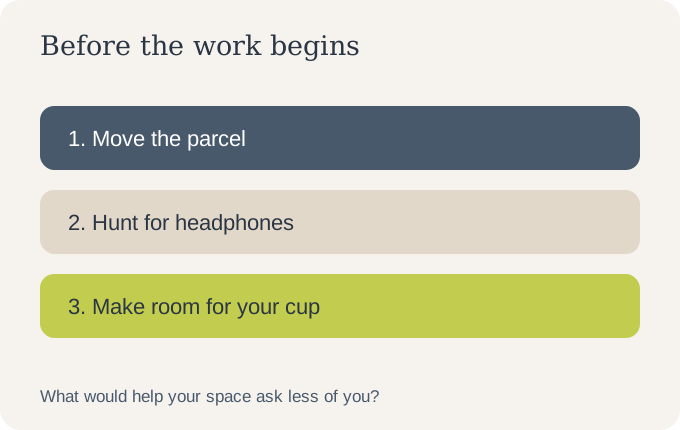
You arrive with your cup and find there is nowhere to put it. A parcel is waiting beside the keyboard. The headphones are in another space. You move the parcel, go looking, and come back.
You haven't begun the work you came here to do. You have been making the desk available.
Notice those moments without asking yourself to push through them. What has to move? What do you search for? What would let you sit down without that first small obstacle?
A usable desk begins there, not with buying another piece of furniture.
You need a place to begin, not an empty desk
A desk can have a lamp, a cup, and something you enjoy looking at. The question is whether you have space for what you're doing.
If the keyboard has to balance on a notebook, that notebook needs a place when you aren't using it. If the desk has become a landing spot for household belongings, those things need homes that aren't the surface you're trying to use.
You don't have to solve every belonging today. Start with enough clear space to sit down and open the laptop.
Then notice what you reach for during an ordinary work session. The headphones may need a hook beside you. The charger may need an easy-to-reach spot that doesn't require crawling under the desk.
Within reach doesn't always mean in view. A shallow drawer can work if you can open it easily and find what you need.
What feels easier at the kitchen table?
There may be something worth bringing back to the desk.
Is the light gentler? Is there more space for your elbows? Can you see outside? Is it quieter, or do you prefer having some familiar sound around you?
Your answer may be different from someone else's. Sensory support doesn't always mean less light or less sound. It means paying attention to what fits you.
If glare makes the screen hard to use, look at the screen's position and the window light. If your video-call background keeps drawing your attention, notice what is in view and whether you want to change it. You don't owe anyone a styled background.
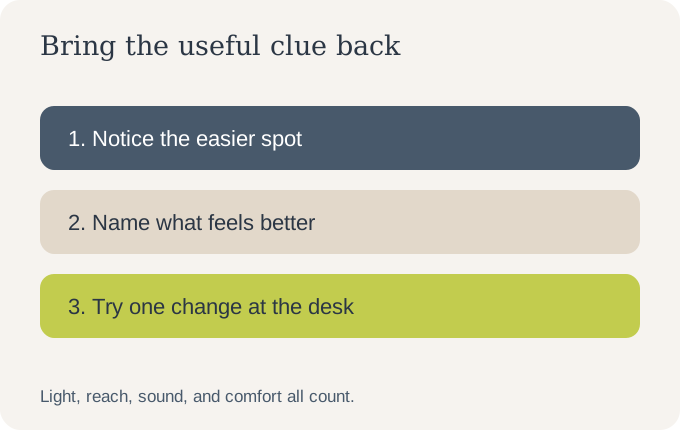
Try the desk again, one change at a time
- Notice one thing that sends you elsewhere. Name the physical obstacle: nowhere for the cup, missing headphones, or light you find uncomfortable.
- Change that one thing. Give the headphones a reachable home, clear the place beside the keyboard, or try a different position for the lamp.
- Use the space before adding more. Pay attention to what is easier and what still gets in your way. That tells you more than a photograph of the finished desk.
- Leave yourself a way back. When you finish, return the few things you need for your next start. Keep the reset small enough for the day you have.
This is structure, rhythm, and sensory meeting in one small space. A home for your headphones. A moment to return them. A place that feels comfortable to use.
You don't have to work out the arrangement alone
Sometimes another pair of eyes helps you see the step you've been working around.
In a Jump-start hour, you show me one physical space in your home, live on video. A home-office zone can be that space. You move the belongings, and I guide the work and explain the reasoning. You keep the final say.
The hour is $150. It includes the PDF overview of the Simply Spacial Method™ and a clear next step. It isn't a promise to finish the whole office. This is help with the physical space, not a filing system, digital organization, or commercial workspace.
If you'd like to look at your desk with me, you can book an hour below. You can bring the space as it is.
— Kim