When Your Home Office Spreads Through Your Home
Your laptop can move with you. The rest of your home still deserves a way to become home again.

A charger on the kitchen counter. A notebook on the dining table. Your laptop on the couch, where you took the last call.
Now you want to sit down with your dinner. First, the notebook has to move.
It is a small thing. But when work belongings stay in several places, you keep meeting them in the parts of your day that aren't for work.
You may not need to stop moving around your home. You may need somewhere for those things to return to.
If you live with ADHD or autism, a change of setting may feel useful at times. If you live with depression or other mental health challenges, your energy may also shape where you spend the day. Neither means you have failed at having a home office.
Follow one notebook before you clear every surface
Where was it used? What made the dining table the place to open it? And what happened when you finished?
Perhaps the table had more space. Perhaps you wanted the daylight. Perhaps you needed to be there for a call and moved on to something else afterward.
The place where work lands can show you what was missing from your usual setup. But it can also show you a perfectly reasonable choice for that moment.
The useful question isn't whether you stayed at the desk all day. It's whether your belongings have somewhere to go when that moment is over.
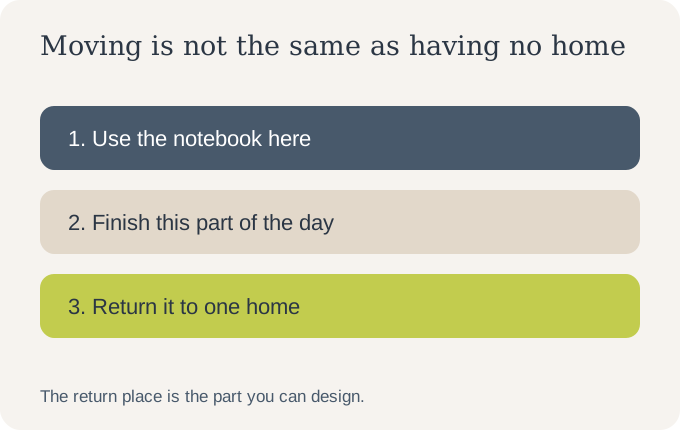
Give work a return place
A home for your work belongings doesn't have to be an office with a door.
It might be one shelf beside your desk. It might be a section of a cabinet, or a basket that fits your laptop and notebook without crowding them. Use something you already own if it works.
The place needs to be easy to reach when you're done. If returning the notebook means moving a stack of other things, leaving it on the table may still feel easier.
Think about visibility, too. You may want the basket in view so you remember it. Or you may prefer it behind a cabinet door so work isn't beside you all evening. Choose what supports you, not what makes the best picture.
A shared space can have two uses
The dining table can be a place you work and a place you eat. It doesn't have to lose one use to earn the other.
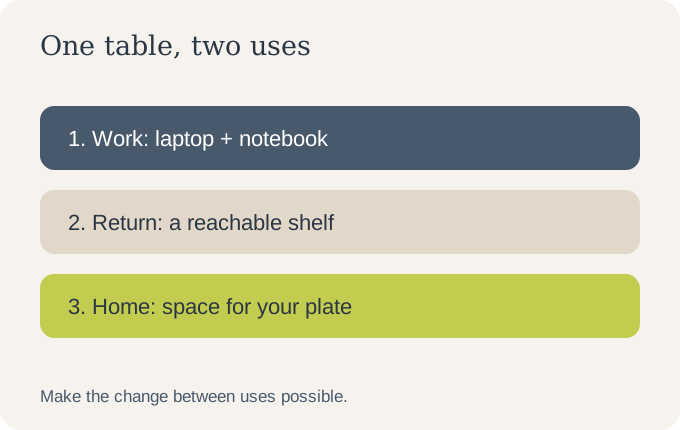
What helps is making the change between them possible.
For you, that might mean closing the laptop and putting it on its shelf before setting out your plate. A lamp you use while working might switch off. Your headphones might return to their hook.
These are choices you can recognize. They don't guarantee you will stop thinking about work, and they don't replace boundaries around hours or expectations. They can make the physical space available for the next part of your day.
You don't need to buy a divider or redecorate before you can try that.
Make the return small enough for the day you have
- Choose one surface you want back. The place where you eat, sit, or rest. You aren't resetting the whole home.
- Choose a reachable return spot. Check that the laptop, notebook, and charger fit without needing a second round of sorting.
- Connect returning with something that already happens. Closing the laptop or preparing to eat can be your reminder. Pick the moment that makes sense in your day.
- Keep a smaller version for tired days. Returning the laptop and notebook may be enough today. If you miss the reset, you can use the same place tomorrow.
There is no required two-minute finish. Notice how long your version takes and what makes it difficult. If the return is becoming another project, make the arrangement easier.
Let the table be a table again
You don't need a larger home to begin asking what belongs where. And you don't need to make yourself stay at a desk that doesn't fit how you use your home.
Start with the notebook. A home for it is structure. A moment to return it is rhythm. Choosing what you want to see and feel when you sit down is sensory.
Those small choices can support the life happening around your work.
If you'd like help seeing where to begin, my free five-day Home Organizing Starter Course walks you through understanding your space and choosing one starting spot. Nothing to buy or sort before you begin.
You deserve a place to put your dinner, too.
— Kim